

0



I am ready for a long road flight for work with a week- or months-long projects.
How to Choose Swimwear: Protection vs Tanning Fabrics
- The Old Rulebook
- A Third Path
- More Than a Filter
- Why the Effect Doesn't Wash Off
- Solving for Privacy Without Sacrificing the Effect
- The Bigger Picture: Less Cream, Less Impact
- What Level of Protection Should You Actually Expect?
- How This Is Actually Tested
- Not Classic Coverage
- RoDa: Le Soleil, Autrement
RoDa was built to question that assumption.
The Old Rulebook
Traditional fabrics work on a simple principle: the tighter the weave, the more ultraviolet radiation they block. Dense synthetic fibers, dark dye concentrations, and thick construction can stop the vast majority of UV rays from reaching skin - which is exactly the point of classic protective fabric. It's effective, but it's also absolute. The same density that blocks harmful rays also blocks the light your skin needs to tan, which is why fully covering fabrics and an even tan have traditionally been mutually exclusive.
On the opposite end sits tan through swimwear - fabric built with thousands of micro-perforations designed to let sunlight pass through almost unfiltered. This category solves the tan-line problem beautifully, but it does so by offering only a thin, low-grade layer of filtration - usually just enough to take the edge off direct exposure, comparable to the lightest sunscreens on the market. Anyone wearing it still needs to treat their skin as largely exposed, applying and reapplying sunscreen exactly as they would on bare arms or shoulders.
Two philosophies, two compromises. Block everything and lose the tan, or let everything through and accept the exposure.
On the opposite end sits tan through swimwear - fabric built with thousands of micro-perforations designed to let sunlight pass through almost unfiltered. This category solves the tan-line problem beautifully, but it does so by offering only a thin, low-grade layer of filtration - usually just enough to take the edge off direct exposure, comparable to the lightest sunscreens on the market. Anyone wearing it still needs to treat their skin as largely exposed, applying and reapplying sunscreen exactly as they would on bare arms or shoulders.
Two philosophies, two compromises. Block everything and lose the tan, or let everything through and accept the exposure.
A Third Path: Filtering Instead of Blocking or Surrendering

RoDa's approach doesn't sit at either extreme. Instead of choosing between a barrier and an open door, the fabric is engineered to act as a filter.
The technology combines a micro-porous fabric structure with the specific engineering of the yarn itself - the two working together rather than either one doing all the work. This combination allows the material to:
- Partially reflect ultraviolet radiation before it reaches the surface of the fabric,
- Let through a reduced, controlled amount of light rather than the full spectrum,
- Redistribute and scatter light as the fabric moves and shifts against the body.
More Than a Filter: How the Fabric Feels
Sun-filtering performance is only half of what makes the fabric interesting. The same density, elasticity, and structural tension that manage light also give the material a shaping effect.
Worn against the body, the fabric behaves in some ways like structured shapewear:
Worn against the body, the fabric behaves in some ways like structured shapewear:
- It gently supports the silhouette,
- Visually smooths and aligns the lines of the body,
- Creates a feeling of being held together and comfortable in motion.


Why the Effect Doesn't Wash Off
Sunscreen has a built-in flaw: it degrades. Water, sweat, and time all reduce its effectiveness, and it needs to be reapplied every couple of hours to keep working.
RoDa's filtering effect is different because it's a property of the fabric and yarn themselves, not a topical layer. As long as the piece is cared for according to the brand's guidelines, that filtering behavior stays consistent for the life of the garment - it doesn't rinse away in the pool, sweat off during a run on the beach, or fade over the course of a long day in the sun. That consistency is also what reduces how often you reach for a bottle of sunscreen in the first place.
RoDa's filtering effect is different because it's a property of the fabric and yarn themselves, not a topical layer. As long as the piece is cared for according to the brand's guidelines, that filtering behavior stays consistent for the life of the garment - it doesn't rinse away in the pool, sweat off during a run on the beach, or fade over the course of a long day in the sun. That consistency is also what reduces how often you reach for a bottle of sunscreen in the first place.
Solving for Privacy Without Sacrificing the Effect
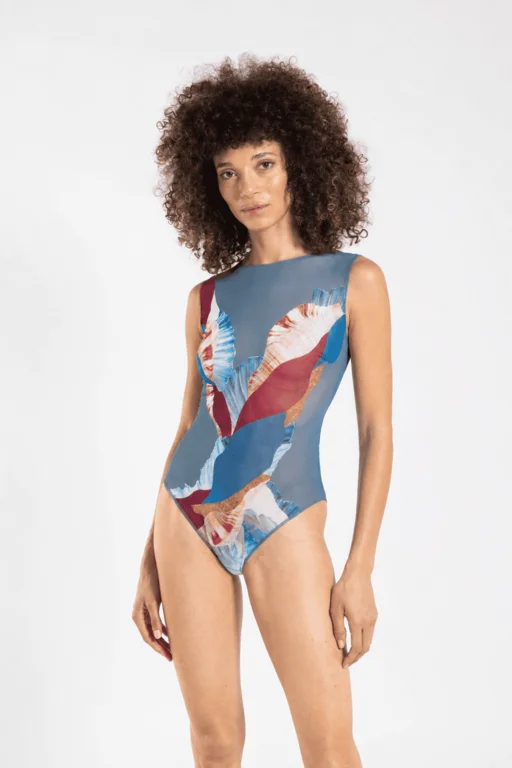
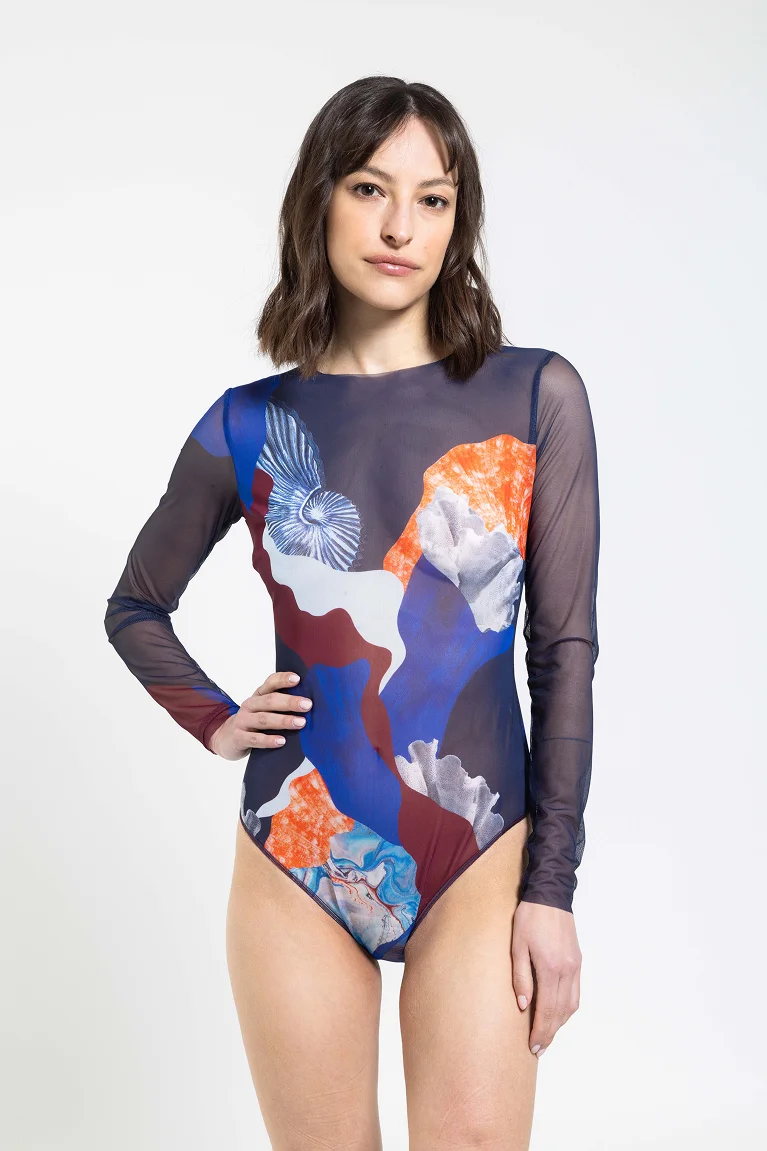
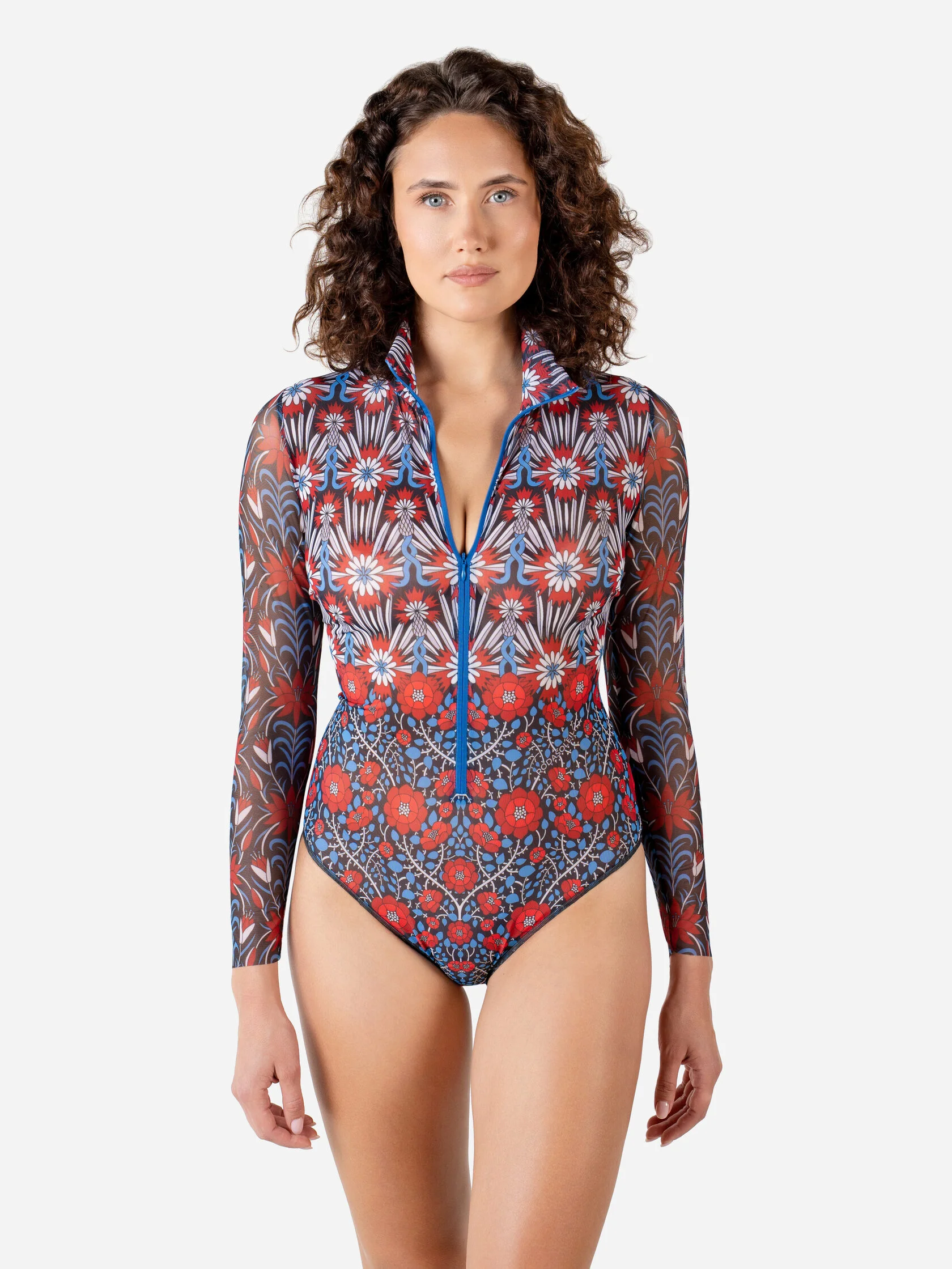
A fabric designed to let some light through will, by nature, be more translucent than a heavily woven material. RoDa addresses this at the design level rather than the fabric level: the brand's original prints are constructed specifically to visually deny that translucency, creating a surface that reads as opaque and fully covered while the underlying material continues to do its job.
It's a deliberate dialogue between engineering and art - function handled by the yarn and weave, appearance and privacy handled by the print. That tension between what the fabric physically does and what it visually communicates sits at the center of the RoDa design identity.
It's a deliberate dialogue between engineering and art - function handled by the yarn and weave, appearance and privacy handled by the print. That tension between what the fabric physically does and what it visually communicates sits at the center of the RoDa design identity.
The Bigger Picture: Less Cream, Less Impact
Every year, an estimated several thousand tons of sunscreen end up in the ocean, where chemical filters have been linked to damage in coral reefs and marine ecosystems. It's a cost of sun protection that rarely gets discussed alongside SPF numbers on a bottle.
Because RoDa's fabric reduces how often sunscreen needs to be applied and reapplied, it also reduces how much of it eventually washes into the water. Combined with the brand's use of recycled materials in production, the environmental case builds in two directions at once - less textile waste on the manufacturing side, and less chemical runoff on the wearer's side. Fashion and responsible consumption end up pointed in the same direction rather than working against each other.
Because RoDa's fabric reduces how often sunscreen needs to be applied and reapplied, it also reduces how much of it eventually washes into the water. Combined with the brand's use of recycled materials in production, the environmental case builds in two directions at once - less textile waste on the manufacturing side, and less chemical runoff on the wearer's side. Fashion and responsible consumption end up pointed in the same direction rather than working against each other.
What Level of Protection Should You Actually Expect?
It's worth being precise here, because clarity protects skin better than marketing claims do.
RoDa garments offer a level of filtration comparable to a moderate sunscreen and help reduce the risk of sunburn when paired with sensible sun habits. That is not the same as full-coverage, zero-exposure protection — any skin left uncovered by the garment still needs its own separate protection, and people with particularly sensitive skin should limit direct sun time and check in with a dermatologist if they're unsure how their skin will respond.
The children's line follows the same principle, offering a comparable moderate level of filtration suited to longer stretches of play in the sun, provided general sun-safety guidance is followed. Beach t-shirts in the collection sit at a lighter level, roughly equivalent to SPF 15–20 — enough for casual cover, but not a substitute for the swimwear line's core fabric when longer exposure is expected.
RoDa garments offer a level of filtration comparable to a moderate sunscreen and help reduce the risk of sunburn when paired with sensible sun habits. That is not the same as full-coverage, zero-exposure protection — any skin left uncovered by the garment still needs its own separate protection, and people with particularly sensitive skin should limit direct sun time and check in with a dermatologist if they're unsure how their skin will respond.
The children's line follows the same principle, offering a comparable moderate level of filtration suited to longer stretches of play in the sun, provided general sun-safety guidance is followed. Beach t-shirts in the collection sit at a lighter level, roughly equivalent to SPF 15–20 — enough for casual cover, but not a substitute for the swimwear line's core fabric when longer exposure is expected.
How This Is Actually Tested

The filtering performance isn't a marketing estimate - it comes from the physical characteristics of the fabric and yarn, evaluated through the brand's internal development protocols. Testing involves participants with a range of skin phototypes, assessed across three areas:
- How the material behaves under sun and water exposure,
- Comfort, both how it feels and how it performs over time,
- How skin responds during extended wear.
Not Classic Coverage — a Different Relationship With the Sun
Conventional fabric built to fully block ultraviolet light does so through sheer density: a tight enough weave simply won't let much of anything through, sun included. RoDa's approach is built on a different premise entirely - dosed permeability rather than exclusion. Instead of shutting the sun out, the fabric transforms the quality of the exposure, softening it and adapting it to the skin rather than eliminating it outright.
That distinction is also what shapes the tan itself. A tan still forms because of ultraviolet exposure — that part of the biology doesn't change. What changes is intensity: the fabric passes through only a portion of the light spectrum, softening the aggressiveness of that exposure and encouraging a tan that develops more gently and more evenly than one built through unfiltered sun.
That distinction is also what shapes the tan itself. A tan still forms because of ultraviolet exposure — that part of the biology doesn't change. What changes is intensity: the fabric passes through only a portion of the light spectrum, softening the aggressiveness of that exposure and encouraging a tan that develops more gently and more evenly than one built through unfiltered sun.
RoDa: Le Soleil, Autrement
Sometimes innovation isn't something you see - it's something you feel.
That's the level RoDa is designed to work on. A swimsuit where the fabric and yarn act as a filter rather than a wall: light still gets through, but it arrives softer. The tan comes out more even. The relationship with the sun feels less combative.
The silhouette isn't forced into shape so much as gently gathered. The material shapes the body the way good foundation garments do - without effort, without stiffness, almost without you noticing.
Visual transparency stays exactly that: visual. The prints hold the balance between openness and privacy, turning the surface of the fabric into something closer to an optical illusion than a simple barrier.
And perhaps the part that matters most happens outside the garment itself. Less cream on the skin means less residue in the water - a simple piece of logic where aesthetics quietly becomes ecology.
RoDa doesn't protect you from the sun in the traditional sense. It offers a different way of meeting it.
That's the level RoDa is designed to work on. A swimsuit where the fabric and yarn act as a filter rather than a wall: light still gets through, but it arrives softer. The tan comes out more even. The relationship with the sun feels less combative.
The silhouette isn't forced into shape so much as gently gathered. The material shapes the body the way good foundation garments do - without effort, without stiffness, almost without you noticing.
Visual transparency stays exactly that: visual. The prints hold the balance between openness and privacy, turning the surface of the fabric into something closer to an optical illusion than a simple barrier.
And perhaps the part that matters most happens outside the garment itself. Less cream on the skin means less residue in the water - a simple piece of logic where aesthetics quietly becomes ecology.
RoDa doesn't protect you from the sun in the traditional sense. It offers a different way of meeting it.
Special offer
Ready for the perfect tan? Choose the smart RoDaSoleil swimsuit.
Get a more even tan without white marks from your swimsuit and enjoy comfort on the beach, by the pool, and while relaxing.
— Innovative tanning technology through fabric
— Quick drying after swimming
— Comfortable fit and high-quality materials
— Wide selection of smart swimsuits
— Quick drying after swimming
— Comfortable fit and high-quality materials
— Wide selection of smart swimsuits